Parma FC SpA would high likely bankrupted again after a decade, or at least an auction of the residual asset and formation of new company. But why? In recent years Parma was keen on cashless player swap with other clubs with financial trouble (such as bankrupted Ascoli, Padova and Siena), which the pricing of the players were suspicious. Moreover with a squad of over 100 players, did Parma really playing lottery in order to make profit from underrated players? However, despite Cesena discovered Parolo, the club barely covered their investment from Chievo when Cesena sold Parolo to Parma in 2013. Or would Parma able to discover another Giovinco? Giovinco was a special case that Juventus want to block the player transfer to archrival Internazionale, which may be a trick between Inter and Parma to aid the finance of Parma, or Juve willing to feed Parma for a excessive 11 million EURO.
However, with EURO 85,786,101 asset value of the player contract, Parma only able to compare with Cesena, which had 16 points as of 16 February 2015, which only have a squad worth EURO 21,766,600 in accounting on 30 June 2014, or Sassuolo which had a value of 31,793,341 EURO on 31 December 2013. Sampdoria, had 39.076 million EURO on 31 December 2013.
How high 86 million is? Juventus squad "worth" 120 million EURO only (30/06/2014), which Milan "worth" 118 million on 31 December 2013. Or look at non-giant: Lazio, 35,936,631 EURO, Roma 89.156 million EURO.
Despite we knew Parma ranked 7th last season, however even entered Europa League, the TV revenue would not able to sustain from an amortization of over 20 million a season, which generated from players that not existed from the first team squad, such as Andrea Rossi (720,000 per season until 2017), or Thomas Fabbri (500,000 per season until 2015). Mauro Cioffi (520,000 per season until 2017), Andrea Rossini (640,000 per season until 2017) Francesco Finocchio (400,000 per season until 2018). Unlike Porto that individual players would able to act as warrantee in order to secure loan from the banks, (as well as forbidden by FIFA), no one actually buy flops. If deducting the value of the squad to reflect the actual value, say, the squad actually worth 50 million in accounting, then the actual net equity would be negative 15 million, not the paper value of 9,560,255 EURO on 30 June 2014.
That's why the club was sold for a peppercorn of 1 dollar, as the club was actually in deep insolvency few years ago. Without a sugar daddy to run the club, but in terms of raising debt, the club better folded again to rebirth.
Tuesday, 17 February 2015

Thursday, 5 February 2015
How broke Brescia would be?
First of all, according to the filing to Italian Chamber of Commerce (CCIAA: http://registroimprese.it)
At the financial year end on 30 June 2014, Brescia Calcio SpA had the following key figures:
Total Assets: €47,159,960
Net Assets = Net equity: €2,754,794
Turnover of the season: €23,141,359
Net profit (loss) of the season: minus €8,679,133
The trend of net profit already an alarm for the second division club which finished as the mid-table in 2013-14 season. However, the breakdown of the figures were worst.
In 2013-14 season, Brescia profited from player trading for €14,182,529, however €7,797,696 of them were from the last minute cashless player swaps with Varese, Pescara, Cesena and Bologna in June 2014. (or €7.8 million revenue) All of gain of Brescia were 100% flops as either reserve players or Lega Pro players namely Pachulia, Iunco, Galassi, Boccaccini, Camilli, Fonte and Gabrielli.
Deducting that amounts from net loss as well as from the assets, Brescia in fact had a net loss of €16,476,829; total asset of €39,362,266 and net equity of negative €5,042,902, which certainly triggered Italian law to recapitalize the company.
Last but not the least, as Brescia had used the financial trick before, which means in their intangible assets, more than €7.8 million were yet to be proven their paper value, including Canini (around €800,000 residual value on 30 June 2014, 2013 signing), Ferri (around €1.2 million residual value on 30 June 2014, 2012 signing) as well as the bought back of Belotti on 2 September 2013, which his contract residual value would around €1,066,667 on 30 June 2014. Adding those up, would be around €10,866,667. Compare to actual value declared in the bilancio, which the whole residual value of the contract of the first team "worth" €10,990,732, the flopped signing represented 98.87% of the accounting value. So, if deducting the value, the net equity would be minus €8,111,873.
Certainly we could argue the accounting value of the player, which based on the signing fee as well as amortization (weathering) , would differ from the actual market value if the players were sold , which on 5 February 2015 this essay was written, transfermarkt estimated the market price of the squad would be €10.7 million. However due to the well known community based elements of the site, the value were not reliable.
The fate of Brescia would certainly based on the recapitalization by the current owner, or a new buyer willing to pay extra to buy the club (as well as recapitalization) due to they think the club worth more in brand name or goodwill than in accounting (which based on historic value), or a promotion to Serie A. If those measures failed to achieve, Brescia could used the player swap financial trick again, however would the club followed the same fate as AC Siena SpA, which also raised paper profit by player swap for few years before bankruptcy?
Tuesday, 3 June 2014

Wednesday, 26 February 2014

Tuesday, 6 August 2013
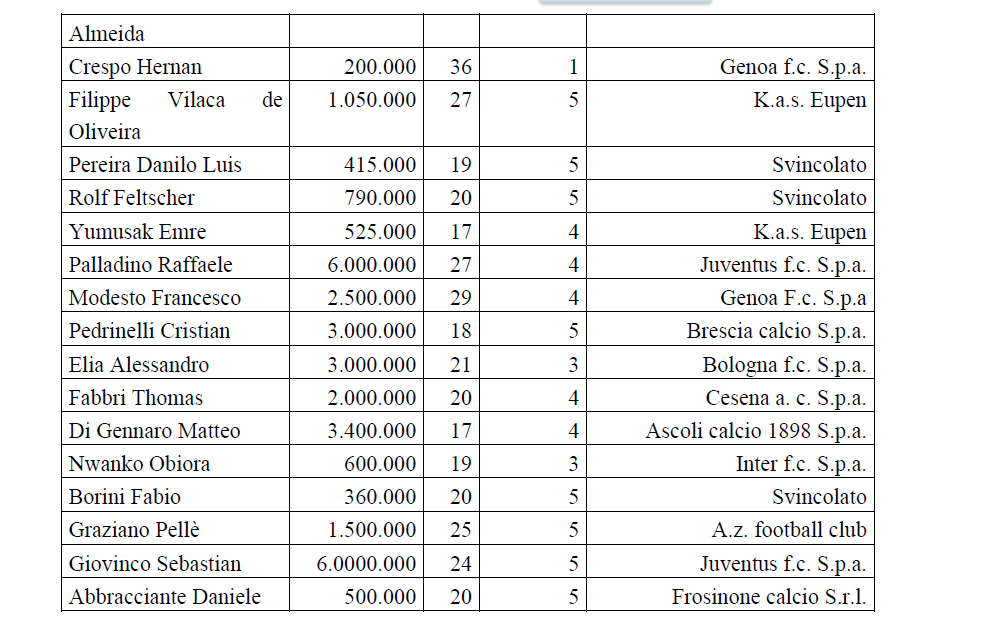
Basic maths problem in Parma FC financial report 2011-12
At first, you need to get a copy to follow my post. Or you had to rely on the screen capture i uploaded.
It is crazy to know that such as tiny club had a player selling profit of over 50 million EURO, which the best player in human market, such as Porto and Arsenal only had this kind of gain for 29,133,050 Euro (note 26 in report) and 65.456 million pound sterling respectively.
Also, partially it was the weakness of the accounting standard to present the co-ownership deal of Giovinco, who returned to Juventus for 11 million EURO (Parma booked a revenue of 22 million assume it is a full ownership and book a co-ownership cost of 8 million as well as decrease in co-ownership debt of 3 million), thus the true profit less Giovinco was 42,448,451 EURO. However, if we had to half the revenue of co-ownership, then we had to half Pambianchi (thus 125,000) Coppola (thus 655,500), Galli (thus 1,937,500), Doumbia (thus 484,400) , Galuppo (thus 1,200,000), Lapadula (1,399,853.5), Defrel (1,174,032), Finocchio (1,000,000), Colomba (950,000), Mantovani (900,000) and Borini (1,671,420), which the profit would be around 31 million. However, the residual value of the player would also affected by co-ownership, for example, Giovinco cost Parma 3 million only, with 25% weathering (excised 1 out of 4 year of the contract), the residual cost should be 2.25 million, thus the profit should be 8.75 million for the 50% registration rights. However, the profit presented was 9.5 million (17.5 million minus 8 million co-ownership cost), why? It is because Parma had to weather 1.5 million instead of 0.75 million.
Why assume the retained 50% registration rights had the same value as the rights actually sold? Lazio and Juventus treated the co-ownership better to reflect the actual situation. Co-ownership somewhat a bonus clause, in rare case the club got nothing if they did not pay the residual (Miccoli from 7 million to 2.39 million, rumor to be the error of Fiorentina or cash flow problem), or luckly a third club buy the player and club A and B fifty-fifty the revenue. Most of the time the mother club eventually gave up the co-ownership for free. It is a double-edged sword that both value of production (selling profit) and cost of production (amortization) increased, if all co-ownership were treated as full ownership. But Italian FA (FIGC) had been using a few financial indicator as a criteria for license, thus you will judge why value of production was so importance and why club made deal so often in the transfer market but the players were often loaned out......
Moreover, most of Parma's profit except Borini and Giovinco were from player swap, mostly without cash. It is a zone of morality or even false accounting as the "market" price (or nominal money price) of barter economy mostly based on valuation of the both club, instead of made reference to similar player in the cash market, thus easily create false asset. If value all barter deal to peppercorn, Parma short term result would be chaos but in long term cost of production would be saved. However value valuable player for peppercorn also caused under estimation of asset and false alarm of negative net equity. It is another thesis to use tools such as transfermarkt to estimate the true financial position of Parma.
Last but not the least, refer to the title, why i'm saying Maths? After reading Parma's accounts, seems they prepared the tables in a hurry.
Friday, 14 June 2013
Pazzini-Cassano and the Milan derby
Not everyone thing Pazzini-Cassano is a wise deal, or it is polarized by which team they support.
To me, it is another derby in UEFA Financial Fair Play. Firstly, it was so surprised that Milan balanced their book in 2012 calender year, which if excluding the ~30M EURO profit from Silva and adding Silva and Zlatan were left in mid-2012 thus saved a large sum of wage for half a year, the result was magnificent . However on Inter side, failed to sell Julio Cesar, Maicon and Sneijder for the right time, were only a few minor mistake. More mistake was on buying old age striker such as Palacio, as well as long delay of replacing Milito.
It is logical that selling Pazzini to save cost. Pazzini's transfer fee was 19 million and 4/1/2 year contract, thus, a 4.222 million amortization was on Pazzini. However either Pazzini was a flop, or Inter did not suit him, selling him for 13 million EURO is wise (13 minus residual accounting value 12.666, still some profit). However, the direct replacement of Pazzini was Cassano and/or Cassano+Palacio seems not a maths of 2 under quality striker is better than 1.
Nothing wrong in Cassano deal. 5.5M transfer fee and 2-year contract, thus 2.25M amortization, lesser than 4.222 million to compensate the undisclosed wage gap between Cassano and Pazzini. However adding Palacio and Milito into consideration, three old forward (or unbiased term: in downwards slope) with star-level wage, the result would be horrible injury crisis of this season.
Football is crazy. There were reliable few years ago, but did not prove the were still energetic in their 30s. Moreover, except Real Madrid and Barca had one of the top super strikers (and YOUNG except Villa), not every team could shown a maths that add up of 3 reliable strikers means more reliable. It did not have any thing to backup the thought that 3 players had difference rise and down period.
Football should be mean. Milito was a average buy in 2009 as it cost 28M in 4-year contract (plus 2M unknown cost shown in 2009-10 Inter audit report), the treble should made that year amortization be 14M not 7M (eventually Milito extended a year in during that season), as Milito should always a front loaded asset, every time he celebrate his birthday is bonus to the team.
However in football club the accountants seldom use impaired clause. It is not logical that Milito still "worth" 12M on 30 June 2012, still, some crazy man willing to offer the transfer fee and also meet the wage demand. Inter should offload him long ago instead of let go of Livaja. The let go of Milito save cost, and moreover, grow more young striker that Inter missed, such as Destro for only 4.5 Million, which current raised to 15 million, or more. Inter should aimed for UEFA FFP, that, should have more balanced wage structure to be more competitive. Inter with Messi nor Brazilian Ronaldo did not proven success, as the era of Beckham(or Figo)-Pavon policy have proven football is a team sports, 1 star and 10 players from lower divisions would not a champion team. With a huge net loss in 2011-12 season, how Inter could improve immediately is nearly a crazy agenda. The new blueprint of Inter, should be avoid the loophole of kick out from UCL thus without income, without income cut cost (as FFP prevent fresh "investment" from owner to cover net loss), cut cost than more difficult to go back to UCL. MM may think FFP was a tool to kick out Milan, Chelsea and Manchester City thus they support the idea, but he did not notice that, high chance to be kicked out, was Inter.
Monday, 3 June 2013
True value of Falcao
Football market was venerable to money laundering. Apart from that, tax evasion is a global trend of corporate culture. Recently Falcao multi-million transfer to AS Monaco FC, but is that his final destination, and how parties other than his former clubs to have a share in that insane figure?
Falcao arrived Porto in 2009. As a public company, Porto had to disclosure the financial detail of their transfers. On 15 July 2009, Porto announced that Falcao was signed for EURO 3.93 million for 60% economic rights. We did not know when the 40% gone, is that River Plate already cash-in the 40% earlier, or a financial trick to store the transfer fee offshore, or looting from the board of director or even Falcao had an "agent" since starting his football career and ask for money from every club Falcao had played. The latter was most common in Brazil and even whole Latin America, entrepreneur or even gang member borrow money to young talent in order to avoid them to become child labour in the factor but footballers, in exchanged for lifetime revenue to the lender.
We could not found "River Plate" in the 2009, which probably the deal was paid in COD basis (cash-on-delivery). Despite it is a public company, unlike Italy which they attached a player identification table to the audit report, which, on the table had contract value, capitalized acquire fee, amortized amount of capitalized fee, selling value and player loss and profit, Portuguese regulation was looser. In Portugal, there is difficult to trace every transfer fee paid and received in the report. As many deal were paid in COD, the sum of current and non-current debt /credit could not reflect the true fee.
Then how Porto acquired the remain 35% economic rights? In the report, Porto sold all its 60% economic rights of Bolatti to Natland Financieringsmaatschappij BV for EURO 1.5 million, and operação realiza da no âmbito do processo de aquisição da parcela de 40% do passe do jogador Falcao which Porto despite disclosed Falcao was related to Bolatti, it did not disclose the actual fee Porto acquire Falcao from Natland. More mystery was 40% became 35% as 5% was resold to terceira entidade. Is that Natland was the middle man, which Natland actually acquire Falcao from the true investor and retained 5%, as the case of fellow Monaco player Moutinho?
Then Falcao's record in the net had attracted many European clubs. Porto immediately, increase the release clause in the player contract, to EURO 45 million, with an agent fee EURO 6,585,150. A month later, Falcao was sold for EURO 40 million plus bonuses. It sounds profitable, but adding 3.93 + 1.50 + 6.59 = 12.02 (Porto revealed that it was 10.629 M after amortization), its means, in 2009 Falcao probably cost 8.1M EURO in order to amortized to 4.05M in July 2011, which the revenue also had to deduct the agent fee again (3,705,000) and the portion to Natland (1,805,000), and lastly solidarity contribution (2M). Moreover, as the payment was in zero interest installments, a further 1,690,000 had to be deduct to be reflect the present value of the transfer revenue to 2011 year, which, after overall deduction, only 16.11 million profit in historical value basis, or 20.3M in amortization method. The latter was more realistic as 4 million amortization in 2-year was impaired with the goals Falcao bought.
Lastly, 12,095,150 agent fee within 2 months, is that really provide service or using contract extension to hide the true proportion of third parties ownership? In the debt table of 2011-12 audit report, Orel BV, Natland, and Mendes' Gestifute, all involved in both extension and selling. Adding up the sum, would find 5,247,650 million was paid in COD and the rest was 6.8475M debt:
 consider Falcao fee was actually paid in installments, such high priority to receive 10 million within 2 year, shown how profitable the agent industry is and how messy of Portuguese football by involvement of double faced agent-investor.
Falcao arrived Porto in 2009. As a public company, Porto had to disclosure the financial detail of their transfers. On 15 July 2009, Porto announced that Falcao was signed for EURO 3.93 million for 60% economic rights. We did not know when the 40% gone, is that River Plate already cash-in the 40% earlier, or a financial trick to store the transfer fee offshore, or looting from the board of director or even Falcao had an "agent" since starting his football career and ask for money from every club Falcao had played. The latter was most common in Brazil and even whole Latin America, entrepreneur or even gang member borrow money to young talent in order to avoid them to become child labour in the factor but footballers, in exchanged for lifetime revenue to the lender.
We could not found "River Plate" in the 2009, which probably the deal was paid in COD basis (cash-on-delivery). Despite it is a public company, unlike Italy which they attached a player identification table to the audit report, which, on the table had contract value, capitalized acquire fee, amortized amount of capitalized fee, selling value and player loss and profit, Portuguese regulation was looser. In Portugal, there is difficult to trace every transfer fee paid and received in the report. As many deal were paid in COD, the sum of current and non-current debt /credit could not reflect the true fee.
Then how Porto acquired the remain 35% economic rights? In the report, Porto sold all its 60% economic rights of Bolatti to Natland Financieringsmaatschappij BV for EURO 1.5 million, and operação realiza da no âmbito do processo de aquisição da parcela de 40% do passe do jogador Falcao which Porto despite disclosed Falcao was related to Bolatti, it did not disclose the actual fee Porto acquire Falcao from Natland. More mystery was 40% became 35% as 5% was resold to terceira entidade. Is that Natland was the middle man, which Natland actually acquire Falcao from the true investor and retained 5%, as the case of fellow Monaco player Moutinho?
Then Falcao's record in the net had attracted many European clubs. Porto immediately, increase the release clause in the player contract, to EURO 45 million, with an agent fee EURO 6,585,150. A month later, Falcao was sold for EURO 40 million plus bonuses. It sounds profitable, but adding 3.93 + 1.50 + 6.59 = 12.02 (Porto revealed that it was 10.629 M after amortization), its means, in 2009 Falcao probably cost 8.1M EURO in order to amortized to 4.05M in July 2011, which the revenue also had to deduct the agent fee again (3,705,000) and the portion to Natland (1,805,000), and lastly solidarity contribution (2M). Moreover, as the payment was in zero interest installments, a further 1,690,000 had to be deduct to be reflect the present value of the transfer revenue to 2011 year, which, after overall deduction, only 16.11 million profit in historical value basis, or 20.3M in amortization method. The latter was more realistic as 4 million amortization in 2-year was impaired with the goals Falcao bought.
Lastly, 12,095,150 agent fee within 2 months, is that really provide service or using contract extension to hide the true proportion of third parties ownership? In the debt table of 2011-12 audit report, Orel BV, Natland, and Mendes' Gestifute, all involved in both extension and selling. Adding up the sum, would find 5,247,650 million was paid in COD and the rest was 6.8475M debt:
Monday, 1 October 2012

Saturday, 30 June 2012
AC Milan bilancio 2011
http://www.acmilan.com/uploads/club/bilancio2011/pages/large/page-000.jpg
http://www.acmilan.com/uploads/club/bilancio2011/pages/large/page-001.jpg
http://www.acmilan.com/uploads/club/bilancio2011/pages/large/page-002.jpg
http://www.acmilan.com/uploads/club/bilancio2011/pages/large/page-003.jpg
http://www.acmilan.com/uploads/club/bilancio2011/pages/large/page-004.jpg
http://www.acmilan.com/uploads/club/bilancio2011/pages/large/page-005.jpg
http://www.acmilan.com/uploads/club/bilancio2011/pages/large/page-006.jpg
http://www.acmilan.com/uploads/club/bilancio2011/pages/large/page-007.jpg
http://www.acmilan.com/uploads/club/bilancio2011/pages/large/page-008.jpg
http://www.acmilan.com/uploads/club/bilancio2011/pages/large/page-009.jpg
http://www.acmilan.com/uploads/club/bilancio2011/pages/large/page-010.jpg
http://www.acmilan.com/uploads/club/bilancio2011/pages/large/page-011.jpg
http://www.acmilan.com/uploads/club/bilancio2011/pages/large/page-012.jpg
http://www.acmilan.com/uploads/club/bilancio2011/pages/large/page-013.jpg
http://www.acmilan.com/uploads/club/bilancio2011/pages/large/page-014.jpg
http://www.acmilan.com/uploads/club/bilancio2011/pages/large/page-015.jpg
http://www.acmilan.com/uploads/club/bilancio2011/pages/large/page-016.jpg
http://www.acmilan.com/uploads/club/bilancio2011/pages/large/page-017.jpg
http://www.acmilan.com/uploads/club/bilancio2011/pages/large/page-018.jpg
http://www.acmilan.com/uploads/club/bilancio2011/pages/large/page-019.jpg
http://www.acmilan.com/uploads/club/bilancio2011/pages/large/page-020.jpg
http://www.acmilan.com/uploads/club/bilancio2011/pages/large/page-021.jpg
http://www.acmilan.com/uploads/club/bilancio2011/pages/large/page-022.jpg
http://www.acmilan.com/uploads/club/bilancio2011/pages/large/page-023.jpg
http://www.acmilan.com/uploads/club/bilancio2011/pages/large/page-024.jpg
http://www.acmilan.com/uploads/club/bilancio2011/pages/large/page-025.jpg
http://www.acmilan.com/uploads/club/bilancio2011/pages/large/page-026.jpg
http://www.acmilan.com/uploads/club/bilancio2011/pages/large/page-027.jpg
http://www.acmilan.com/uploads/club/bilancio2011/pages/large/page-028.jpg
http://www.acmilan.com/uploads/club/bilancio2011/pages/large/page-029.jpg
http://www.acmilan.com/uploads/club/bilancio2011/pages/large/page-030.jpg
http://www.acmilan.com/uploads/club/bilancio2011/pages/large/page-031.jpg
http://www.acmilan.com/uploads/club/bilancio2011/pages/large/page-032.jpg
http://www.acmilan.com/uploads/club/bilancio2011/pages/large/page-033.jpg
http://www.acmilan.com/uploads/club/bilancio2011/pages/large/page-034.jpg
http://www.acmilan.com/uploads/club/bilancio2011/pages/large/page-035.jpg
http://www.acmilan.com/uploads/club/bilancio2011/pages/large/page-036.jpg
http://www.acmilan.com/uploads/club/bilancio2011/pages/large/page-037.jpg
http://www.acmilan.com/uploads/club/bilancio2011/pages/large/page-038.jpg
http://www.acmilan.com/uploads/club/bilancio2011/pages/large/page-039.jpg
http://www.acmilan.com/uploads/club/bilancio2011/pages/large/page-040.jpg
http://www.acmilan.com/uploads/club/bilancio2011/pages/large/page-041.jpg
http://www.acmilan.com/uploads/club/bilancio2011/pages/large/page-042.jpg
http://www.acmilan.com/uploads/club/bilancio2011/pages/large/page-043.jpg
http://www.acmilan.com/uploads/club/bilancio2011/pages/large/page-044.jpg
http://www.acmilan.com/uploads/club/bilancio2011/pages/large/page-045.jpg
http://www.acmilan.com/uploads/club/bilancio2011/pages/large/page-046.jpg
http://www.acmilan.com/uploads/club/bilancio2011/pages/large/page-047.jpg
http://www.acmilan.com/uploads/club/bilancio2011/pages/large/page-048.jpg
http://www.acmilan.com/uploads/club/bilancio2011/pages/large/page-049.jpg
http://www.acmilan.com/uploads/club/bilancio2011/pages/large/page-050.jpg
http://www.acmilan.com/uploads/club/bilancio2011/pages/large/page-051.jpg
http://www.acmilan.com/uploads/club/bilancio2011/pages/large/page-052.jpg
http://www.acmilan.com/uploads/club/bilancio2011/pages/large/page-053.jpg
http://www.acmilan.com/uploads/club/bilancio2011/pages/large/page-054.jpg
http://www.acmilan.com/uploads/club/bilancio2011/pages/large/page-055.jpg
http://www.acmilan.com/uploads/club/bilancio2011/pages/large/page-056.jpg
http://www.acmilan.com/uploads/club/bilancio2011/pages/large/page-057.jpg
http://www.acmilan.com/uploads/club/bilancio2011/pages/large/page-058.jpg
http://www.acmilan.com/uploads/club/bilancio2011/pages/large/page-059.jpg
http://www.acmilan.com/uploads/club/bilancio2011/pages/large/page-060.jpg
http://www.acmilan.com/uploads/club/bilancio2011/pages/large/page-061.jpg
http://www.acmilan.com/uploads/club/bilancio2011/pages/large/page-062.jpg
http://www.acmilan.com/uploads/club/bilancio2011/pages/large/page-063.jpg
http://www.acmilan.com/uploads/club/bilancio2011/pages/large/page-064.jpg
http://www.acmilan.com/uploads/club/bilancio2011/pages/large/page-065.jpg
http://www.acmilan.com/uploads/club/bilancio2011/pages/large/page-066.jpg
http://www.acmilan.com/uploads/club/bilancio2011/pages/large/page-067.jpg
http://www.acmilan.com/uploads/club/bilancio2011/pages/large/page-068.jpg
http://www.acmilan.com/uploads/club/bilancio2011/pages/large/page-069.jpg
http://www.acmilan.com/uploads/club/bilancio2011/pages/large/page-070.jpg
http://www.acmilan.com/uploads/club/bilancio2011/pages/large/page-071.jpg
http://www.acmilan.com/uploads/club/bilancio2011/pages/large/page-072.jpg
http://www.acmilan.com/uploads/club/bilancio2011/pages/large/page-073.jpg
http://www.acmilan.com/uploads/club/bilancio2011/pages/large/page-074.jpg
http://www.acmilan.com/uploads/club/bilancio2011/pages/large/page-075.jpg
http://www.acmilan.com/uploads/club/bilancio2011/pages/large/page-076.jpg
http://www.acmilan.com/uploads/club/bilancio2011/pages/large/page-077.jpg
http://www.acmilan.com/uploads/club/bilancio2011/pages/large/page-078.jpg
http://www.acmilan.com/uploads/club/bilancio2011/pages/large/page-079.jpg
http://www.acmilan.com/uploads/club/bilancio2011/pages/large/page-080.jpg
http://www.acmilan.com/uploads/club/bilancio2011/pages/large/page-081.jpg
http://www.acmilan.com/uploads/club/bilancio2011/pages/large/page-082.jpg
http://www.acmilan.com/uploads/club/bilancio2011/pages/large/page-083.jpg
http://www.acmilan.com/uploads/club/bilancio2011/pages/large/page-084.jpg
http://www.acmilan.com/uploads/club/bilancio2011/pages/large/page-085.jpg
http://www.acmilan.com/uploads/club/bilancio2011/pages/large/page-086.jpg
http://www.acmilan.com/uploads/club/bilancio2011/pages/large/page-087.jpg
http://www.acmilan.com/uploads/club/bilancio2011/pages/large/page-088.jpg
http://www.acmilan.com/uploads/club/bilancio2011/pages/large/page-089.jpg
http://www.acmilan.com/uploads/club/bilancio2011/pages/large/page-090.jpg
http://www.acmilan.com/uploads/club/bilancio2011/pages/large/page-091.jpg
http://www.acmilan.com/uploads/club/bilancio2011/pages/large/page-092.jpg
http://www.acmilan.com/uploads/club/bilancio2011/pages/large/page-093.jpg
http://www.acmilan.com/uploads/club/bilancio2011/pages/large/page-094.jpg
http://www.acmilan.com/uploads/club/bilancio2011/pages/large/page-095.jpg
http://www.acmilan.com/uploads/club/bilancio2011/pages/large/page-096.jpg
http://www.acmilan.com/uploads/club/bilancio2011/pages/large/page-097.jpg
http://www.acmilan.com/uploads/club/bilancio2011/pages/large/page-098.jpg
http://www.acmilan.com/uploads/club/bilancio2011/pages/large/page-099.jpg
http://www.acmilan.com/uploads/club/bilancio2011/pages/large/page-100.jpg
http://www.acmilan.com/uploads/club/bilancio2011/pages/large/page-101.jpg
http://www.acmilan.com/uploads/club/bilancio2011/pages/large/page-102.jpg
http://www.acmilan.com/uploads/club/bilancio2011/pages/large/page-103.jpg
http://www.acmilan.com/uploads/club/bilancio2011/pages/large/page-104.jpg
http://www.acmilan.com/uploads/club/bilancio2011/pages/large/page-105.jpg
http://www.acmilan.com/uploads/club/bilancio2011/pages/large/page-106.jpg
http://www.acmilan.com/uploads/club/bilancio2011/pages/large/page-107.jpg
http://www.acmilan.com/uploads/club/bilancio2011/pages/large/page-108.jpg
http://www.acmilan.com/uploads/club/bilancio2011/pages/large/page-109.jpg
http://www.acmilan.com/uploads/club/bilancio2011/pages/large/page-110.jpg
http://www.acmilan.com/uploads/club/bilancio2011/pages/large/page-111.jpg
http://www.acmilan.com/uploads/club/bilancio2011/pages/large/page-112.jpg
http://www.acmilan.com/uploads/club/bilancio2011/pages/large/page-113.jpg
http://www.acmilan.com/uploads/club/bilancio2011/pages/large/page-114.jpg
http://www.acmilan.com/uploads/club/bilancio2011/pages/large/page-115.jpg
http://www.acmilan.com/uploads/club/bilancio2011/pages/large/page-116.jpg
http://www.acmilan.com/uploads/club/bilancio2011/pages/large/page-117.jpg
http://www.acmilan.com/uploads/club/bilancio2011/pages/large/page-118.jpg
http://www.acmilan.com/uploads/club/bilancio2011/pages/large/page-119.jpg
http://www.acmilan.com/uploads/club/bilancio2011/pages/large/page-120.jpg
http://www.acmilan.com/uploads/club/bilancio2011/pages/large/page-121.jpg
http://www.acmilan.com/uploads/club/bilancio2011/pages/large/page-122.jpg
http://www.acmilan.com/uploads/club/bilancio2011/pages/large/page-123.jpg
http://www.acmilan.com/uploads/club/bilancio2011/pages/large/page-124.jpg
http://www.acmilan.com/uploads/club/bilancio2011/pages/large/page-125.jpg
http://www.acmilan.com/uploads/club/bilancio2011/pages/large/page-126.jpg
http://www.acmilan.com/uploads/club/bilancio2011/pages/large/page-127.jpg
http://www.acmilan.com/uploads/club/bilancio2011/pages/large/page-128.jpg
http://www.acmilan.com/uploads/club/bilancio2011/pages/large/page-129.jpg
http://www.acmilan.com/uploads/club/bilancio2011/pages/large/page-130.jpg
http://www.acmilan.com/uploads/club/bilancio2011/pages/large/page-131.jpg
http://www.acmilan.com/uploads/club/bilancio2011/pages/large/page-132.jpg
http://www.acmilan.com/uploads/club/bilancio2011/pages/large/page-133.jpg
http://www.acmilan.com/uploads/club/bilancio2011/pages/large/page-134.jpg
http://www.acmilan.com/uploads/club/bilancio2011/pages/large/page-135.jpg
http://www.acmilan.com/uploads/club/bilancio2011/pages/large/page-136.jpg
http://www.acmilan.com/uploads/club/bilancio2011/pages/large/page-137.jpg
http://www.acmilan.com/uploads/club/bilancio2011/pages/large/page-138.jpg
http://www.acmilan.com/uploads/club/bilancio2011/pages/large/page-139.jpg
http://www.acmilan.com/uploads/club/bilancio2011/pages/large/page-140.jpg
http://www.acmilan.com/uploads/club/bilancio2011/pages/large/page-141.jpg
http://www.acmilan.com/uploads/club/bilancio2011/pages/large/page-142.jpg
http://www.acmilan.com/uploads/club/bilancio2011/pages/large/page-143.jpg
http://www.acmilan.com/uploads/club/bilancio2011/pages/large/page-144.jpg
http://www.acmilan.com/uploads/club/bilancio2011/pages/large/page-145.jpg
http://www.acmilan.com/uploads/club/bilancio2011/pages/large/page-146.jpg
http://www.acmilan.com/uploads/club/bilancio2011/pages/large/page-147.jpg
http://www.acmilan.com/uploads/club/bilancio2011/pages/large/page-148.jpg
http://www.acmilan.com/uploads/club/bilancio2011/pages/large/page-149.jpg
http://www.acmilan.com/uploads/club/bilancio2011/pages/large/page-150.jpg
http://www.acmilan.com/uploads/club/bilancio2011/pages/large/page-151.jpg
http://www.acmilan.com/uploads/club/bilancio2011/pages/large/page-152.jpg
http://www.acmilan.com/uploads/club/bilancio2011/pages/large/page-153.jpg
http://www.acmilan.com/uploads/club/bilancio2011/pages/large/page-154.jpg
Tuesday, 12 June 2012




Monday, 4 June 2012
The Problem of AC Milan
Financial fragility of AC Milan is not a news. However what the problem the club faced?
In my point of view, the size of the squad was one of the problems.
In my point of view, the size of the squad was one of the problems.
Right after the closure of 2010 summer transfer windows, Milan had the following players left on loan:
Ferdinando Coppola (worth 400,000 on 30 June 2010)
Marcus Diniz (worth 5,000,000 on 30 June 2009, estimate 4,000,000 on 30 June 2010)
David Di Gennaro (worth 2,500,000 on 30 June 2009, 1,666,667 on 30 June 2010)
David Di Gennaro (worth 2,500,000 on 30 June 2009, 1,666,667 on 30 June 2010)
3 players from Internazionale (worth 7,000,000 on 31 August 2010)
Assuming 5-year contract, that would be 2,980,000 in amortisation. However, Di Gennaro was in 3-year contract, made the case worsen 333,333 .EURO.
Then in 2011-12 season. The arrive of Pele (exchanged with Sampirisi tagged for 2M), Chinellato 3.5M (exchange for Pasini) , the return of Zigoni, Paloschi, Oduamadi , Strasser and lastly El Shaarawy had made Milan invested more than 50 million on young players, again assuming 5-year contract, that would create 10 million amortisation on players not yet ready for the first team. Saving all the cost, 50 million already good enough to buy 2 to 3 players. However, the core of the case was Milan did not purchased the players from Genoa for real money except El Shaarawy and Paloschi, is that another side-effect of parallel trade (creative accounting)?
Then in 2011-12 season. The arrive of Pele (exchanged with Sampirisi tagged for 2M), Chinellato 3.5M (exchange for Pasini) , the return of Zigoni, Paloschi, Oduamadi , Strasser and lastly El Shaarawy had made Milan invested more than 50 million on young players, again assuming 5-year contract, that would create 10 million amortisation on players not yet ready for the first team. Saving all the cost, 50 million already good enough to buy 2 to 3 players. However, the core of the case was Milan did not purchased the players from Genoa for real money except El Shaarawy and Paloschi, is that another side-effect of parallel trade (creative accounting)?
Tuesday, 29 May 2012

Friday, 16 March 2012
Plusvalenze: a case study
To run a business, you need money. If the company had a negative equity (liability great than total asset) and a continuous net loss, the company may be in the state of bankruptcy. Either the shareholder re-capitalized immediately, or the bank wait for the economic recovery.
In the case of Chelsea FC plc, the club had a negative equity for years but it just owe the owner money. And the Russian converted all the debt to equity in recent years, to make plc debt free (but not the holding company of the plc: Fordstem Ltd.)
What composite the asset of a football club? Usually it was the stadium (which only Juventus only owns its) and intangible asset (brand name, player contract) . In the past the Italian sold its own brand to its subsidiaries, which just means the club write a new "fair value" to its brand. However, the Italian banks accepted the new "market value" of the brand and borrow money to the club, and the club itself had to amortize the brand in years. The result? Roma, Milan had a positive equity as a separate company but a huge negative equity as a group. And Internazionale even did not had a consolidated accounts for the club and the company "Inter Brand"! It is because the repayment of debt was much slower than the "weathering" of the asset value of the brand! The only club had a positive equity as a group of these company was SS Lazio. The club sold its brand to subsidiary "SS Lazio Marketing & Communication S.p.A." and the club still had a positive equity of 10 million EURO. While Roma, also sold its brand to "Soccer S.A.S. di Brand Management s.r.l.", now had a negative equity of 43 million (2010-11 result)
No one wanted to liquidate the club, as the bank would got nothing but the "brand name". However it is a problem if the club had a negative equity for a long time. Would FIGC forced the owner to inject the right amount to save the club, or the bank write-down the debt? Roma was a special case as the whole Sensi Group was taken by the bank in return of just 30 million. Is that anymore club administrated by the bank in the future?
Another way to "save" the club was player-exchange. The asset value of a player was based on the acquire cost. Thus, Barcelona probably was always under-valued as they had one of the most successful youth system in the world. However, if Barca exchange star player with Man.Utd. or Real Madrid, thus both clubs had a mutual benefit as both clubs now had a real market value on his youth product. That's nothing immoral, as the youth system did not produce star players in every position, and without exchange deal, the player probably sold to a third club for cash in order to buy a new player from the fourth. A little drawback of this method was, the transfer fee in the exchange deal despite did not involve cash, the deal may still had a value for both players, and the profit on selling the youth product (usually equal to the increase in total asset or the transfer fee), had to offset by the amortization cost in the next few years (consider it was the cost of weathering of the players) So it just borrowed the future money to "create" the selling profit.
So, that the relation of false accounting of Italian clubs and player exchange? In the past Italian club exchange youth product that did not became a professional in order to create enough asset for the routine check every year. FIGC fined the clubs but no charge for the adult players, as it is hard to prove the aim of valued the players price so high was evil. However, we saw Roma lost Bovo in this trick.
And the player exchange is back. As Serie A "small" clubs predicted they would probably get a increase in TV revenue by collective agreement (bad news for big club). Clubs were targeting to stay in Serie A as well as minimal re-capitalization, why not borrow the increased money to save the current season?
Let's have a look in Chievo account. On 30 June 2010, Chievo (AC ChievoVerona s.r.l.) had a positive equity of about 600,000 EURO. However, Mattia Minesso already worth 2 million. Who is he? Transfermarkt only estimated him below 300,000 EURO. (Despite transfermarkt did not had a real academic criteria to estimate the value). On that deal the book of Chievo also had a player "worth" 1 million: Daniele Rosania. And On 30 June 2011, despite the club had a net loss, it was counter-weight by a capital increase of 250,000 EURO, and the equity stood at about 600,000.
However, on the asset, which consist of about 20 million EURO of player asset. Which contains (we cannot got the full list as it was not attached to the financial report) Hetemaj (2.8M) Amedeo Benedetti (2M, recently returned from Vicenza), Alessandro Bassoli (3M, recently signed from Bologna), Filippo Tanaglia (1M, recently return from Ascoli), Andreolli (1M), Iunco (198,000), Amedeo Calliari (at most about 350,000, assume contracted until 2015 the max. length) Moreover, Chievo had a toxic asset of another half of Enrico Alfonso, which worth 1.9 million in accounting. Inter would be fool to buy the another half but it may pushed Chievo to bankruptcy .
Among, the player asset, only Hetemaj and Andreolli were in true accounting and market value, there other? Lack of Serie A and even Serie B debut, they may prove their value in the future or just another toxic asset just aimed to inflate the equity level to positive. For Iunco, his return to Chievo was an accident, but without the fool of Torino president, he only brought 20,000 EURO to Chievo. For Andreolli, despite he had a fair player history, without the help of Inter, his accounting value should be weathered down from 800,000 to 640,000 (assume 5-year deal) or even 533,333 (assume 3-year deal as reported). On the good side Roma forced to sell him in 2010 as he would became free agent in 2011, so 1 million may be his true market value if he preformed well. To sum up, if deducting Benedetti (2M), Bassoli (3M) and EURO 160,000 of Andreolli, Chievo already had a negative equity of 4.5 million.
Would FIGC and the department of justice of Italy (what's the exact name of the dept?) do something. Or do nothing but after the club bankrupted?
P.S. Coming up would be a little research on Parma, Genoa, Bologna and Milan account.
Monday, 27 February 2012
Genoa CFC, a football club or a factory?
Since promoted back to Serie A, Genoa always finished in mid-table except a single UEFA Europa League entry. The squad changed, from Rubinho to Amelia, Eduardo and Frey. Why the squad so unstable? Actually Genoa profited on Bonucci and Ranocchia before they made their club debut.
It is a nightmare to operate a club in Italy. Low gate income, discrimination of TV income, made a few Serie A club made a profit. Genoa was lucky: net loss of EUR 3,720,686 in 2006-07; a net profit of EUR 1,504,757 in 2007-08; from 1 July to 31 December 2008 a net loss of EUR 7,829,339 and 2009 a whole year of net profit EUR 598,212.
While the equity of the company was a negative of EUR 217,266; a positive of EUR 1,787,492, a negative of EUR2,541,847 and in 2009 a positive of 3,457,940. It means, Preziosi actually only need to re-capitalize a few million in order to keep the level merely above the water table.
Bonucci was a piece-weight of Motta and Milito deal. In that deal, Milito actually cost Genoa a few million (<10million), and Motta, a free agent. The result? 28 million and 10.2 million. Despite a cash-plus player deal, Genoa bought Bonucci for 3 million and re-sold half to Bari for 1.75 million, Genoa sold another half to Juventus for 8 million! 8+1.75 - 3, that's how Genoa operate. Genoa also successfully sold Bolzoni after a loan (0.4M for loan, and 1.05M for 50% registration rights= 1.45M, moreover Genoa had gain 0.2M from Frosinone for loan). Only Acquafresca, with a price tag of 9.5 million, became a flop. The case of Meggiorini still uncertain. A 5million price tag, sold half to Bari but Bari could not afford to buy another half, made his single season with the southern Italy side a 0.96 million loan. Genoa also bought him back from Bologna for the same price the club sold him to Bologna, yet another free loan. Torino recently bought half of the tag but Genoa could got nothing for the rest. Genoa was good at scouting and develop players. It knew when the players started to shine, the club could not afford their wage. And keeping them, did not mean a consistent result. Moreover, good result, Europe qualification, means bigger squad, bigger wage bill but imbalanced revenue grow. They aimed for Europe because it is the destination of the showroom, a winter sale. However Genoa also failed to keep the back bone to keep the result stable. Udinese, however, sold Quagliarella, Motta, Sanchez, Pepe, D'Agostino, Inler and Zapter without affecting the result.
Back to the numbers. In 2006-07 windfall profit on players was EUR 6,136,607 (that means, the revenue to sell the player minus its un-amortize asset value) plus a loan income of 35,000. It almost offset the amortization of intangible asset (which most players contract, an way to reflect the transfer fee in installments)
of 8,459,065. Moreover a financial income of 7,288,833 from co-ownership that season (the excess fee what other clubs willing to buy the rest of the card or the discount other clubs gave to Genoa) The financial income exceed the write down of players rights of EUR1,518,007, the loan cost for the arrival of 314,500 and the cost of sending players out for EUR402,000.
Much improvement in 2007-08 season, this time 21,782,405 player profit, Loan revenue was 975,000. amortization was 10,982,644, write down was 1,404,398, loan cost (to and from Genoa) was 794,000 and 939,746 respectively. Lastly a financial income of 400,000 but counter-weight by the cost of 401,990.
In the 6 months from 1 July 2008 to 31 December 2008, the numbers were EUR12,051,762, EUR348,046, amortization was 11,837,028, write down 242,041, loan cost 1,021,000 and 62,750. Lastly a financial income of 92,321.
In 2009 (calender year), which was huge. EUR42,184,032, EUR1,336,376, with amortization of EUR29,843,388, write down EUR4,671,413, loan cost 582,000 and 1,413,366; Financial income of 3,201,500, cost 1,901,000.
What's the use of these figure? It means Genoa generated income from players and exceed the buying cost! the audience paid the wage of the players and other clubs paid for the value-add/scouting service!
However the president was too mad on the football market of 2010, the introduction of UEFA Financial Fair Play made him only able to do dirty flopping youth player value and sell players to Russia. The last fool was Inter which bought Ranocchia for 19million and sell Destro for 4.5 million. Except a few Middle East idiot, FFP forced the club to make economic decision, and then a expected cool down in transfer market by UEFA. Unlike, Udinese, which they really bought South American in very cheap price, buying European as well as young Italian is more expensive, let's wait and see how Genoa is affected by the ice age of "mercato".
Edited on 6 August 2013
----------------------------------------
Eventually in 2010 calender year Genoa had player selling profit of 38,880,710; loan revenue of 2,915,330, co-ownership income 7,050,000
amortization 34,460,995 loan cost (to Genoa) 418,000 loan cost from Genoa 1,268,305, write-down of player 1,401,998 co-ownership cost 5,510,500: Net position: 5,786,242
player wage 47,648,255 TV revenue (including from UEFA) 32,134,601
In 2011, TV revenue 31,968,456, player wage 47,864,712
player profit 62,162,043 (mainly due to friendship with Milan and Inter), counter-option income 500,000, loan income 3,246,250 co-ownership income 17,024,500
amortization 40,801,899 loan cost 2,454,000 and 1,824,140 write-down 3,365,505 co-ownership cost 3,231,000 net position 31,256,249
Tuesday, 27 December 2011
Stacking goalkeeper, A phenomenon of Italian economic crisis?
First of all, did you know these name:
Paolo Tornaghi: Internazionale player
Matteo Trini: Juventus player
Niccolò Manfredini: Fiorentina player
Edoardo Pazzagli: Fiorentina player
Nicola Ravaglia: Cesena player
Ugo Gabrieli: Lecce player
Davide Petrachi: Lecce player
Gianluca Curci: Roma player
Diego Manzoni: Parma player
Serie A clubs stacking goalkeeper, a level that never saw in the past.
It had many reason that players failing to loan out. For example, they were ghost player in order to create fictional profit in player-swap. But most of the name were good player in "Lega Pro", just like Ravaglia, Manfredini and Trini. Did the club wished to stay as a extra cover as fourth keeper, the club wished to stack them in order to listen offer from Serie B? Not every youth product create profit. Inter produced Tornaghi, Bindi, Cordaz and Moreau but none of them create a real profit. (not paper profit from paper swap). Juventus only profited Mirante for 3 million EURO in recent years. However at least someone willing to borrow them, when they had money to pay wage.
In the past Serie A clubs had to pay a portion of TV revenue to Serie B, just like Premier League. However since the set up of Lega Serie A and collective TV bargaining, the obligation to pay Serie B from A also expired. The source of income of Serie B clubs were came from selling youth product to Serie A and a little TV income. The source of income of Serie A club? Serie A were heavily rely on recapitalization or the shareholder loan to survive. However the introduction of UEFA Financial Fair Play in 2010, or even before that, Inter, Milan and Roma started a balanced budget or even a surplus budget in transfer market. In Lega Pro Second Division, the league was shirked from 3 groups to 2 groups. That means about 10 professional team withdrew. For the survived team, they also cut their budget on player wage. Player turned 20 were considered young-professional but player under that age could consider as trainee. Clubs could offered them "young-professional: contract but it was more economical to borrow them from youth team. A professional with trainee wage and experience, is that really a professional? Looking at Melfi squad (http://www.webcitation.org/63wF88qLB) The inexperience squad was an example that how the club survived. Old experienced but slow player no longer existed in the squad. In exchange they were replaced with even more low wage young (born 1989 to 1993!) player.
In the past we saw clubs using player exchange to create profit. Mechanism was sold a youth player (which in accounting it had no value, as value was based on hiring cost) with a certain price (say a few million) to B. But at the same time, B sold another youth player back to A with the same price. If the price was right, there is nothing wrong. Clubs were free to swap their surplus defender with midfielder they need. However most of the deal in turn were flops. Did you remember Alberto Maria Fontana, Marco Varaldi and Martino Olivetti? Profit was created because the selling profit of a player was registered in the accounts instantly, but the acquiring cost was amortize proportionally to player contract. Say, selling a player for 10million and buy another player for 10 million in 5-year contact, would create a net effect of 8million in the first season and 2 million cost in each year in next 4 seasons. Adding the effect of VAT the deal only create cost over time but it do borrow the future revenue to that window. Looking at the recent transfer window. Boateng only signed by Genoa for about 6 million but half of the contract sold to Milan for 6 million but paid via a young striker who tagged for 4 million. In turn Boateng proved his price tag (over 10 million) but Giacomo Beretta? That even worst in Bologna "bilancio" (Italian words for report and accounts) Pisanu-Valiani both tagged for 2.5 million EURO for 50% rights? Pasi-Elia 1 million? Few days before the closure of 2010-11 financial year, Caidi-Luppi for 0.75 million? G.Bassoli-Gregorio for 1million?! Rickler-A.Bassoli for 1.5 million!! It is not illegal to make the deals (or very difficult to prove it was flopped and only for false accounting) but for years it was considered immoral in Italian media. The come back of these deal, was to avoid the negative equity appeared. Braca should used these method as Messi and Xavi were very under rated in accounting. However these players were recently graduated from youth team or struggle to find a place in Serie A. The true market price of Serie B player were below 1million. Most of these players were likely a toxic asset of the club, made the club already faced a negative equity but did not appeared on paper. In 2011 window, Parma also swapped Luigi Palumbo with Thomas Fabbri; while Vicenza was swapped Edoardo Bonicelli with Simone Tonelli. I did not had their accounts and reports yet. It was normal transaction if they had a low price tag, but if the tag was high, everyone know what the purpose was. The deals either delayed the bankruptcy or the club faced its turning point and started to make profit again.
Lets wait and see the fate of Italian football.
Saturday, 23 April 2011
Sampdoria budget
Sampdoria had announced its 2010 annual result. It was a net loss of €12,109,456 (revised from €11.5M.) Compared with 2009, was a net loss of €16,389,970
Wednesday, 23 March 2011
fate of Manchester United? (updated 29/3)
Red Football JV Limited had a loss of 105million pound in 2009-10 seaseon.
Despite Manchester United is one of the wealthiest club in the world, however the parent company of the club, Red Football JV Limited, was heavily affected by the debt. Thanks Glazer.
The structure of the club ownership is as follow:
Glazer family > Red Football JV > Red Football Limited > Manchester United Limited > subsidiaries (including the team itself, MUTV, etc.)
(intermediate holding company ignored , source)
Manchester United Limited was healthy. Red Football Limited had a EBIT of £27.3 million, but the total recognized losses of the financial year was £84.3 million due to the interest expenditure, which it had a net debt of £357.8M.
That's not the full story, Red Football JV Limited 2009-10 result, which could be obtained in the "Companies House", shown the group had a pre-tax loss of £109M, which isn't a good sign. In 2008-09 season the pre-tax profit of RFJV was £21.6M, which mainly due to the sale of Ronaldo (profit of selling players in 2008-09 season was £80.7M) The net debt was £566M in 2008-09 season.
Glazer is clever. He borrowed money to buy a hen which can lay golden egg. And bankrupt of the parent company did not affect the team itself. When the parent company was liquidated, the banker still able to sell the subsidiary without affecting the business. The net asset of RFJV was stood at £37.M in 2008-09 season. Sound inexpensive? But Glazer rejected an offer of £1.6 billion from Qatar ruling family. That's is, if Qatari only buy the the team itself and Glazer needed to clear the debt by its means, he still received net cash of about £1 billion, and if the Qatari bore the debt, that's mean it would cost more than £2billion. Glazer borrowed money to buy Manchester United, it is a good profit as he did not take his own money to buy it, but now he is the owner, and he knew there are potential buyers, and the family can borrow easy money from the group, just let see Glazer when he sold it for a new world record.
Wednesday, 2 March 2011
Post-Tsunami of economy? Half-yearly result of Football industry (2010-11)
| Team | Net income (loss) |
| Arsenal Holdings plc | |
| Red Football Ltd. | |
| Tottenham Hotspur plc | |
| Birmingham International Holdings Ltd | |
| Rangers FC plc | |
| Celtic plc | |
| Juventus FC Spa | |
| AS Roma Spa | |
| SS Lazio | |
| SL Benfica - Futebol, SAD | |
| Sporting Clube de Portugal - Futebol, SAD | |
| FC Porto - Futebol, SAD |
Tuesday, 1 February 2011
Financial fair play
If everyone are criminals, then crime did not existed.
Here is the rule and how the European giants smack UEFA.
In the one hand Chelsea announced its operating loss of 2009/10 season was £68.6M, its broken the British domestic transfer record of £50M on the same day. Just like hiking, when you think you reached the peak, a long road is waiting for you to finish.
The rule will started from 2011/12 and the check will on 2013 for reviewing the aggregate result of 2 previous season. However, seems not everyone listen and started their reform.
And it is easy to cheat. Juventus once sponsored by FIAT, its sister company. For Manchester City, the UAE tycoon is one of the sons of UAE president and Emir (king) of Adu Dhabi, it is much easy to find a shirt sponsor. Who knows the economic effect is positive or not in the Airlines account? They just want to say i am rich. Italian once used a method of cross-trading to false accounting. A rubbish player tagged for a few billion, both club exchanged it, made it asset became larger. Clubs may now use a method of trading footballers and non-football asset. A tiny land worth 1000 billion and exchanged with a player worth 1000 billion, generate 1000million football related revenue and non-football related investment. However this method only benefited one club. If the figure became smaller, such as 1 to 2 million euro, it should help to narrow the gap without finding irregularity.
And it is easy to cheat. Juventus once sponsored by FIAT, its sister company. For Manchester City, the UAE tycoon is one of the sons of UAE president and Emir (king) of Adu Dhabi, it is much easy to find a shirt sponsor. Who knows the economic effect is positive or not in the Airlines account? They just want to say i am rich. Italian once used a method of cross-trading to false accounting. A rubbish player tagged for a few billion, both club exchanged it, made it asset became larger. Clubs may now use a method of trading footballers and non-football asset. A tiny land worth 1000 billion and exchanged with a player worth 1000 billion, generate 1000million football related revenue and non-football related investment. However this method only benefited one club. If the figure became smaller, such as 1 to 2 million euro, it should help to narrow the gap without finding irregularity.
If there is a law but no one comply and no one get caught, the law does not existed. If everyone is a robber, they it is fool not to robbery.
In the other hand, did every European giant spent wiser? Real Madrid only signed the Togolese troublemaker, but he is famous for his greed. Wages also counted in the fair play and will he stay? Bayern Munich had a big pocket for future signing, but the long term break-even differ from short-term fluctuation. Manchester United operating profit (EBITDA) was positive in 2008/09 season Arsenal wage cost was increased in 2009/10 season but its football related profit (EBIT) was £44.8M For Liverpool, the Uruguayan and the Toon soldier were actually paid by Chelsea, by acquiring the Spaniard. So the net investment is small. For the Cinderella, Džeko is expensive and the club wage cost exceeded its income. But the club could use a tricky way to balance the book. It hired many good players and selling them counted as football-related income. If they successfully loaned out, it cost zero to the club but before that their value should be write down to zero, i.e. no amortization cost required. So a record breaking loss in 2010-11 season may created a false break even in the following 2 seasons. However it cannot last long.
Go to Italy. Inter was quiet in the summer but became the big spender in the winter. To lead the race under financial fair play, building a team before the transfer fess are counted. The amortization is high in the first year, but by extending and extending the contract, the amortization cost could be lower until a sudden increase of writedown by the retirement or selling. The rule blocked any team to spend too much in one season (as it would increased the amortization suddenly), but a team could spent a lot in one season and then keep not spending in the following season, if it is good enough. (i.e. the amortization raise in the first year and then decrease/constant as old player life span rate is difference) Despite under the rule, they only required a aggregate breakeven of a certain period, it is still risky to spend too much in one window. (note that income did not reflect immediately after player investment as sponsorship and TV revenue were pre-agreed, and not all the team winning the champions league and/or local title and got the prize money, dividends of TV watcher increase depends on contract and the only effect is on the season ticket and shirt sale) Juventus re-build its squad in 2007 and 2008 , but in exchange they were flops. Remember Tiago and Amauri? The clubs just can't predict they can closed their pocket. So in January 2011 became the last spending chance. Gamble the last chance the amortization was not counted. In the other hand. The old age of Milan cannot prevent the big spending in the following year, or you think Milan still has a world-class young defensive line? Only Thiago Silva counts. The good news is UEFA has a provisional measures: the loss could be covered by the decrease of shareholder equity (and such likes) of a certain degree. But saving this season profit as reserve for future season , could not prevent the future decrease of shareholder equity (and such likes). Fine tune a team is safer than big spending. Lastly, Juventus net loss of 2009-10 season was 10 million euro and they had a net investment of 24million in the summer "calcio mercato" and could raise to 66.6million if all the buy option excised. While Roma was 22 million net loss .
UEFA did not allowed clubs to cover the loss by the blank check of banker, and selling land and hotel. Portuguese seems deal with the rule with issue new share (but claiming the shareholder equity clause again and again?) and issue bonds. Porto is good at buy-low sell-high and they may survived.
Would all the clubs failed the break-even condition and no big clubs in UEFA Champions League? Would there be a new G-14 league? Lets see.
Subscribe to:
Posts (Atom)